
OVERVIEW
This is my 8th Rover outing.
You’d think I should be pretty good at this by now, eh? NOPE. After each event, I quietly sit down, reflect, and write down all the failures or weaknesses in a lessons learned document. This document never shrinks, as there’s always something that needs fixing- even after 3 years of doing this event.

Each new outing is a challenge. When you fix one issue, it often unmasks another new one. As Paul Shack (Space Shuttle Chief Engineer) used to say about trying to resolve all the latent issues with a space radio system we were developing, “it’s like peeling the layers of an onion…”.
We’d also often use the phrase, “the known unknowns” to describe the awaiting issues under each onion peel.

That’s part of the business ‘flying’ a complex ham shack, whether fixed or as a rover. And it’s also mimics the NASA wash cycle: document, analyze, track, test, verify, and re-fly. This brings to mind the well too familiar NASA jargon soup that lives within the psyche of everyone in this business:
- DR’s (Discrepancy Reports),
- RID (Review Items of Discrepancy)
- FIAR (Failure Investigation And Reporting),
- FEMA (Failure Events and Modes Analysis), r
- PRACA (Problem Reporting And Corrective Actions)
- UA (Unexplained Anomalies)

I can’t say it keeps us young, and it doesn’t keep us off the streets. But it sure keeps ones’ minds honest and sharp.

THIS 8TH ROVE EFFORT

Rove #8 was another retribution effort, that is- I failed before and was darned committed to try again. This was 600 miles of traversing through several rare maidenhead grid square multipliers up the middle of central Texas, DM90-94, and return back home through a route of more populated grids. I’ve now done this route 4 times in a row, and I can finally claim that I successfully activated this route with only few minor issues. Last year’s failed attempt also carried a burden for not fulfilling a special request from Brad WQ5S who needed contacts with the 2 rare grids, DM90 and DM92 on the 222 MHz band. But this weekend– we successfully got it done. Mission accomplished!
What was new for this rove?
– New 222 MHz Transverter with significantly better stability
The terribly drifty Elecraft XV222 was replaced with a stable 222-28CK Down East Microwave unit graciously gifted by K5LLL.

– New 902 MHz radio with new 902 loop yagi antenna


My efforts to build up a K5TRA 902 transverter kit is temporarily sidelined by the purchase of a gently used DEMI 902-28I 902 MHz transverter liquidated from W5ZN’s shack.
– New 432 MHz amplifier RFC 4-310, which modestly boosted my IC9700 RF output power from 60W to 120W
– Updated WSJTX/N1MM SO2R (Single Operator 2 Radio) SW setup configurations
– New custom-made Transverter IF switchbox. This breaks out a single IF TX/RX line and PTT input and distributes it out using relays to individually isolated outputs for up to 8 Transverters! (thank you ebay)

New issues (partial list)
– Excessive frequency drift with the 902 MHz radio
– Low power output measured on several bands.
– 6m amp shutdown at 200W
– 222 MHz amp shutdown at 70W
– 1.2 GHz intermittent connection
– 50 MHz Stressed Moxon high SWR (resonant at 60 MHz!)
– Cable snags on rooftop mini-tower during rotation
<14> service loop catches on the top rim of the mini-tower.
– Rotor controller inaccuracy (do to snagged cable?)
– Bunch of new SW bugs
PREPARATION
The planning of the setup and routes began 3 months before the event.
This is a statement of the excitement seeing plans evolve and becoming a real deployment.
Without fail, there’s always a last minute surge to get stuff done, but wisdom has to take over and “fish or cut bait” must prevail
For example, the night before I rushed trying to get a 2.3 GHz system built up in time for the contest.

I had already installed a 30 turn 2.3 GHz Helix antenna, which I previously picked up cheap at the hamfest, on the rooftop mast,

so all I needed was an RF system in the car. Note it became loosened in the wind and points out of alignment from the stack. The rushed attempt included stitching together an Adlam PLUTO SDR radio, a 1W amplifier, and some T/R switching and power modules. I almost got it mounted together for a test run, but it was already midnight and I needed to get up at 4AM to begin my drive for the contest. I smartly aborted the 2.3 GHz effort in time to get at least 3-4 hrs of sleep. I will leave this project for next time, with adequate time to test, setup and possibly use a bigger amp.
One of the challenges for this rove was that I was spending 50% of my time at my daughter’s house helping with grandkids care taking along with the XYL. This meant that time in College Station was sans my test bench, parts, and equipment. Soldering and testing could only be done with a cheap amazon soldering station, and the few tools and equipment that I outfitted in her house. Parts would be ordered through the mail vs tapping directly into my cache of parts in the ham shack. Overall, this was very inefficient and added to the layering of time needed to get everything done. Additionally, helping watch a 3 month old and 3 year old duty left no time to play radio during the waking hours. Also, my wife and I were also serving family support for our other grandkids in Katy, where our support was needed to attend 4 year old and 3 year old sports activities and caretaking duties were required due to parents’ work and travel. No complaints but this sure was a different vision of an easy going slow paced retirement 😉


The assembly of the antennas is usually tough, but I think I’ve got the process down:
1. Install the mini-tower and rotor with U-bolts secured around the roof racks

2. Install the mast and upper antennas

3. Hang the 2m, 1.25m, and 432m yagis using the Directive Systems Quick Release plates


4. Bring coax ingress


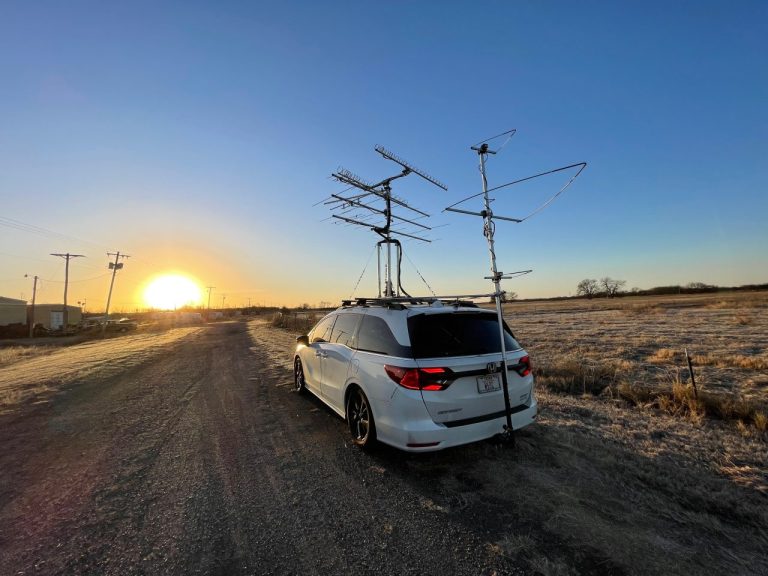
Ingress of the coax lines was wonderfully improved by using popsicle sticks as “splints” to keep them oriented inline. This allows the back window to be raised up snugly to the coax. It not only forms a better weather proofed entry (using pipe insulation foam), but also reduces the drag and a quieter ride at freeway speeds. Luckily my wife, Donna, had some of these popsicle sticks in her arts and craft cache.
5. Install back mast with 2m/6m omnis.
This goes on last because once installed, I can’t access the hatchback.

Artificial Intelligence.. HA!
I decided to let technology help out by using CHATGPT and Google GEMINI to suggest candidate sites to exploit for best elevation and likely link paths to Ron, Brad and another ham that frequents the contest. I ran numerous requests from these AI engines during the few weeks of planning ahead of time. The analysis revealed impressive ingestion of data from various online databases, as it flashed the integration of data processing on the monitor. I thought for sure, I would have superior location solutions across these AI suggested sites. Not. Overall, the candidates were marginal if not poor. Also, during the use of AI, I would sometimes get stupid results, for example asking me to physically trek up a large hills, even though I specified roadside stops along major roads. Sometimes, it would direct me in the middle of a town which was clustered with building obstructions. A few times, the results were located far outside from the requested target grids. None, of the solutions used, actually produced anything extraordinary. Yep, ArtificialIntelligence–its intelligence was quite artificial for me.

Saturday- Contest Start
From College Station, I needed a 7 hours start on the road in order to arrive at the first grid square in DM90 El Dorado. In the past, I usually arrived late because of last minute issues, and I usually started late due to unforeseen issues on the day of the contest. For this one, I had 2 days of testing so most of the system was pre-tested and ready to go.
I arrived in El Dorado 1 hour before contest start.


This early leeway gave me a comfortable option to securely park at my planned spot while also pre-activating each band/mode before contest start. The weather was terrific but cool, which portended to lousy tropospheric propagation conditions. Brad WQ5SS, asked for a pre-contest QSO to get his DM90 222 MHz contact request fulfilled early. Success. That was a great feeling to help him out with his missing grid square chase on this band. Upon contest start, a friend and mentor Ron K5LLL successfully ran the bands with me on 6m, 2m, 1.25m, 70cm, and 23cm. He has a BIG analog signal on the VHF/UHF/SHF bands and throughout the last few roves, has tracked me and supported me during these contests.


OVERNIGHT
I spent the night at same motel from previously roves- the Vernon Budget Host Inn.

A cheap, modest, non-descript stay in Vernon, a good halfway spot of the journey. There’s something to say about the comfort of familiarity. I fondly remember the ferocious pesky flies that got into the room during a summer roving stay. The proprietor gave me his fly swatter to hunt them down saying, “we’ll we’re near cow pastures, that why there’s so many flies here”. The fly hunt happened around midnight to 1 am. I couldn’t sleep until the last of the 7 were finally swatted down, since they attacked me while trying to sleep.
As used before, for peace of mind from burglary, I brought along 2 small motion activated 113 dB anti-theft vibration sirens which I placed and activated at the passenger and drivers side door panels. I also activated a mock LED blinker box placed on the dashboard.
And also, like before, the overnight stay is useful to conveniently recharge batteries.

It’s not fun to lug heavy LFP batteries into the room, but a necessary part of the routine. Luckily, I didn’t overload any circuit breakers in the room, as their outlets were already way over strewn with numerous plugs and extensions into the same outlet. Note: I use these LFP batteries to avoid rewiring the power system in my van which would have required an upgraded battery, alternator, and wiring, So the use of batteries seemed to be a simpler solution. (2) 200aH, (2) 100aH, (3) 20aH LiFePO4 batteries and the unmodified car battery power lines are used in my setup.

SUNDAY
The early morning cold snap produced 14F weather during my drive up to OKLA. I have a favorite grid location in EM04 on a smooth dirt clearing adjacent to a sheltered 18 wheeler truck. The sunrise is always gorgeous and it’s a serene place to start the day.


I think this would be a perfect site to conduct MSK144 meteor scatter, since this mode is especially conducive for early morning contacts. It’s another bucket list thing-to-learn. There’s always something to learn in ham radio.
EM14 was just 5 minutes from the EM04, a technicue used by experienced rovers to exploit operating near intersecting grids. Operating at the intersection of 4 grids is commonly used by some folks.

In general, for the Sunday travel route, several stopping spots were the same as before with good results and some were revised with somewhat lousier results. One new stop in particular was exciting to try. On paper using Google Maps and Texas Elevation maps, this location cleared a good path to Austin/Dallas by bypassing some local obstructing hills. I really had hopes of massively excellent line of sight communications. No joy. The only excitement was the stopping of a gas truck by a discerning large and rough man who questioned what I was doing. I told him I was a ham and that seemed to disarm his interest. Maybe he knows were a weird and nerdy bunch of hobbyists?
BTW, I was only asked one more time at a gas station about my setup. The one guy simply approached me as I started walking out of the restroom back to the gas pump and asked, “is that your contraption?!” “I thought you were a weather guy”.
For this route, I brought along a small lighweight fiberglas ladder that I picked up one day while loitering a Lowes. When I spied it, the thought was it would be a good ladder for roving. It was! Worked out great to get ontop of the car to adjust the antenna or to get to the Seasuckers for guy wire tightening. I also used a clever door step that inserts into the inner door latch. This was super helpful to have stability as I used the ladder. One off on this step and one foot on the ladder gave me great stability.

<11> door step.


<43> warning signs a my favorite spot Mineral Wells


SOFTWARE
This rove was more or less highly successful. I only had one SW issue that puzzled me for about 30 minutes of lost operating time in DM93. Somehow the Windows 11 audio setting has disabled one of two audio output devices and prevented me from modulating an FT8 session. I think RFI somehow upset the Intel NUC computer, but that was really a weird one which wasn’t obvious. Much time was expended troubleshooting the radio SW setting and incorrectly suspecting that the CODEC drivers were corrupted or mismatched. Are there such things as ham radio evil ghosts?
I still believe there are too many complicated SW settings both in the radio and computer that prevents this type of operation to be stable and reliable. I haven’t written much about the setup. I’m running N1MM logger software in an SO2R (Single Operator 2 Radio) configuration. This means I can launch 2 coupled instances of N1MM simo. I can then spawn a linked WSJTX instance from each N1MM session. For the K3 radio which operates 6m, 222 MHz (via transverter 28 MHz IF), and 902 MHz (via transverter 28 MHz IF), I use N1MM EW1. For the IC9700 radio which operates 2m, 70cm and 23 cm, I use N1MM EW2.
So, I can simo operate FT8, one on the K3 and one on the IC9700, by using the 2 instances of WSJTX tied to each N1MM session. It should be noted that I cannot jump from SSW/CW to FT8. N1MM and WSJTX cannot operate simultaneously. i.e. I have to shut down the WSJTX session to use N1MM for SSB/CW contacts, and them relaunch WSJTX to use FT8.
But the cool thing about this setup is that all the QSOs get ingested into a common N1MM log file. I was finally only able to successfully get all of these piece parts working correctly on this past rove. Previously, the links were never fully integrated which required me to manually integrated the logs together- a huge manual effort to crosscheck dups and missing data.

The point I wanted to make is that this setup is great when working right, but there are so many potential susceptibilities if something is not working in concert i.e. due to an RFI burst that detaches a driver, or an internal SW issue in Windows misbehavior, etc. I dream of dedicated radios and dedicated SW to decouple everything and making it a masterful Keep It Simple Stupid setup. But alas, that would have issues too, trying to manage a host of separate computers and separate radios…
STILL MORE CHALLENGES
During a previous rove last year, I successfully operated FT8 on 2m and 6m simo. I’ve recently opted not to do this anymore since it seems to introduce too much driving risk. I admit trying to log the QSO and reenable the Transmissions sometimes requires a wandering eye to the monitor and off the road- dangerous and too risky. Yes, I’ve drifted off the road a few times.

Also, when crossing grids, I have to manually switch the grid identifiers 4 times, 2 in N1MM and 2 in WSJTX. This is very hard to do while in motion and not worth driving onto the shoulder to stop and reprogram.
There is an auto grid capability using Bktsyc application, but I’ve not had consistent results in the past to rely on it. Once you get the grid identifications wrong, you screw up the the other ham’s credit and you introduce headaches trying to reconcile the logs afterward.
HEALTH
I got sick on Sunday evening which pretty much wiped me out before I could finish the last 4 hours of the contest. Fortunately, I decided to abruptly QRT as I ended up getting physically sick. Luckily I found a random gas station in mid-travel, and recovered with Tylenol, coke, and 15 minutes of shuteye. I can’t pinpoint the cause, but I’ll guess it was the combination of only getting little sleep over the last few days coupled with the poor choice of coffee overload and a terrible choice of beef jerky and dried mango snacks–, plus the physical fatigue of excessive driving and playing loud radio into my eardrums. I suffered my worst migraine headache which left me with one hand feverishly massaging my temple while driving with the other.
Luckily, after the stop at the gas station, my body recovered enough to get me back to my daughter’s house in College Station- a short 2 hour drive.
THE ADDICTION CONTINUES
During the drive home, I felt like this might be my last rover adventure. I was miserable and found nothing was fun anymore.
Oddly, I’ve recovered completely and am already excited for the next one. I’ve already started a plan to hit new Grid Squares, this time starting off near the Grids by Galveston, driving north and coming back down along the edge of Louisiana. These grids are semi-rare for the VHF/UHF/SHF contest gang and will be a good effort to give folks new multipliers for their logs. That’s very motivating for me.

OPPORTUNITIES NEXT?
This is the fun part. Now that I’ve got a pretty good handle what works and not, I want to do these:
1. Add 2.4 GHz, and 10 GHz for the big SHF/uW guns- K5TRA, K5LLL, W5LUA, ?? near Austin area.
2. Go to new route and explore what works or not.
3. Stay at each planned grid for at least 2 hours vs the 1 hour. This will give me more time to work more skeds and stations in general, and possibly setup a ground based antenna (10 GHz)
4. Investigate the installation of a mast + rotor in the front of the van
5. Investigate the installation of a pneumatic mast at the trailer hitch
6. Rethink 6m antenna. Reinstall a 6m stressed Moxon vs the OA-50 PAR omni, or install a 3 element yagi, or even stack phased 6m omnis.
7. Get more 222 MHz output power. from 60W to 200W.
8. Meteor scatter
9. Add FM mode to the setup.
GIVE IT A TRY
Roving is a super fun activity. you meet new people, make friends, and challenge your abilities to do better. It’s also a wonderful excuse to buy more gadgets, gizmos, and add to your already overloaded ham shack.

POSTSCRIPT
In spite of my proud accomplishment of finally not snagging any of my top antenna elements with low hanging tree branches, I ended up snagging the antennas 2 days after the event ended. While driving back home to League City for setup disassembly, I was asked to run an errand on the way, to pickup and drop off my other grandkids. While approaching the dropoff point at an isolated rustic cabin, I barely avoided running my antennas into a low hanging power line Fortunately, at the very last minute I processed the dangerous clearance issue and veered around the collision, and into the low hanging branches. Whew.

What an incredible adventure! Would make a great short film documentary! Definitely need to submit to QST for a story in an upcoming publication! Your setup is amazing! Congratulations on your success with this roving!
Hi! Super random, but we are driving behind you in West Texas, leaving Marfa. We saw you driving through Alpine and took a picture of your car out of curiosity and used Google Lens to figure out what was going on with your setup and it lead us to this blog post. We learned something new about the Ham radio world today. Good luck with your contest!