
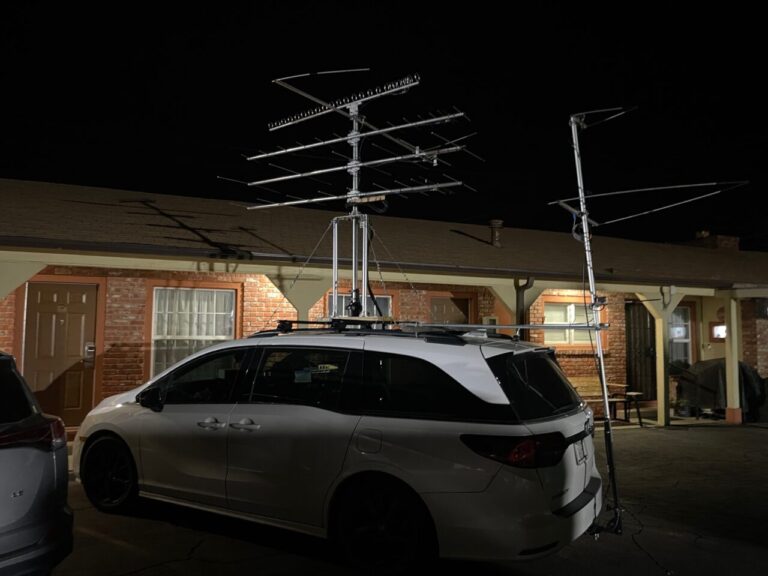
The Rover in a VHF contest is an ultimate challenge for those hams who enjoy developing and testing equipment out in the field. There’s tremendous satisfaction operating a complex radio system that began as a paper design, deployed with hardware and software, and is tested in the field. Kinda like designing, deploying, and flying a space vehicle on a test flight.
Unlike a POTA deployment, the VHF rover radios are a much higher degree of complication.
Multiple radios are integrated together and interfaced with software applications that must pass data across their subsystems. Thoughout the rover journey, all of the equipment is subjected to a large environment of RF and a constant mechanical vibration level that exposes the ruggedness (or lack thereof) of every joint and connection on the vehicle.
This W5OC/R trip replicated the same route taken during the June VHF contest

but with improvements:
– 2 new 200Ah LiFeO4 batteries to power the 200W 50MHz and 144MHz amps
(Previous batteries discharged after initial use)
– 222 MHz transverter
(Previously didn’t work because of missing interface cable)
– Bird Coaxswitches to swap 50Mhz and 144MHz antennas from Omni to Yagis
(Previously, Daiwa coax switches were defective and had poor isolation)
– 24″ VGA monitor
(Previously used a 15″ monitor which couldn’t fully display dual WSTJX windows)
– 2 new large suction cups to strengthen guy wire integrity
(Previous smaller suction cups slipped and slackend guy wires during freeway travel)
What failed on this trip
– A huge 1KHz noise bar on 6m FT8 masked many signals during reception
– The IC9700 failed SSB operation on day 2
– 222 MHz transverter became wildly unstable and impossible to use on FT8
– The coaxwitch knob fell off
– The 1.2GHz antenna got mangled 3 times due to low hanging branches
– The 50MHz antenna pulled apart from a low hanging branch
– A power pole connection to the 222 MHz amp went intermittant
Here’s a few pix of the W5OC/R rover that traveled up and down the mid-west and central Texas regions.

new 200aH LiTime LiFePO4 batteries. These worked great to power the 6m/2m 200W amps all day.

Two new (6″ white) Seasuckers were deployed to improve the smaller (4.5″ black) ones that slipped. Last June, it was discovered that these smaller suction cups slipped to the point of loosening the guys wires used to hold down the mini-tower on the roof.

Here’s an example how fragile the 1296MHz loop yagi is to snagged low hanging branches. I couldn’t reach them even while standing on the rooftop, so I stopped by a Tractor Supply store and bought a 6′ painters pole while gave me enough reach to fix the mangled loops.

The IC-9700 SSB mic audio went out on Sunday, so tried to use CW as an alternative. I couldn’t get the iambic paddle to work, but I did have straight key response on the left side of the paddle. So the paddle was flipped on it’s side and used this setup all day Sunday for CW ops.

I intentionally spent the night at a cheaper motel which had rooms directly beside the parking space. In case anyone decided to break into the car, I could immediately confront the intruder.

I used this fake blinking LED to deter intruders while I slept at the motel. Also I had two of these motion sensors placed in the door pockets. These would activate a siren to hopefully scare away anyone who either opened the door or shook the car.


These were found growing at the spot I stopped at Mineral Wells (oil field). I had never seen these before, but was intrigued how they looked just like a cherry tomato except yellow. Luckily, I didn’t try them (though tempted). These are Horse Nettles, and a members of the nightshade family.

Sunrise in Wairuka, Oklahoma.

Yours truly operating with equipment mounted on a shelving rack. Cable ties and velco kept everything in place

By the way, all gas stations are designed with sufficient ceiling clearance- thankfully. I was constantly approached by curious folks while pumping gas. Yes, most thought I was a storm chaser.

Here’s a backside shot of the equipment rack. If you look closely, you’ll see an abundant use of fix 31, 41, 61 ferrites across data and power lines. Using these makes *all* the difference of having RFI issues or not.

A big part of roving is finding a good spot to pull over. The location needs to preferably elevated and clear or items that might absorb or block RF including hills, trees, buildings, signs. This requires a trained eye and lots of driving skill since sometimes you will need to pull over instantly while driving 75 mph with cars behind you. This is especially dangerous and frightening after sunset because of the limited visibility of quickly finding a good spot while avoiding hidden trenches or someone tail ending your backside.

This is an incredible snapshot of working WM5L literally simultaneously on 6m and 2m. This is called SO2R, Single Operator 2 Radios. Incredibly this event happened in such synchronized unison that we both thought it was a software mirroring error. This one is for the history books.

Sadly, lots of last minute effort went into trying to get this 902 transverter working in time for this contest. Unfortunately, it didn’t get fixed in time. 902 MHz definitely in the plan for the next VHF contest in Jan 2026.
Great detailed synopsis of your adventure and equipment challenges! What an incredible setup in your van! Looking forward to more of your adventures in the near future!
I’m glad to see that you’re being safe with your battery setup by using fuses. Thanks for the write-up and good luck with incorporating 902 MHz into your next roving adventure.
That’s quite a setup you have in your car. Looks like a lot of fun!